G-Client LMS Project Overview
Overview, initial thought-process and project planning.

I build software, design fair systems, and lead solutions that solve human problems.
It's the start of the first week at the Talent Mobility Program with Azubi, and I'd love to take you on a technical tour of our first project. Our first technical project is to build a Learning Management System called G-Client. As a Full-Stack Software Engineer, I have decided to develop both the frontend and backend to have full flexibility to add more functionality later.
I will guide you through my thought process, and my system architecture for the project and then dive into the code later.
Roles and Actions
G-Client has two main roles: a user can sign up as either an Admin or a Learner. Each role has its dashboard or panel. Therefore, there is authentication for both administrators and learners.
An authenticated Admin can:
Add tracks
Add courses
View learners
Issue invoices
and manage reports.
A learner can:
View available tracks
Preview a track
Enroll in any track
Rate a track
Both can update their profiles. These, therefore, are the major modules of the project. We first focused on Admin-related activities before moving on to Learner-related operations. Now that you have an overview of the project, let's dive right in.
The project is divided into four phases for Admin and another four phases for Learner. In the next articles, we will be diving into the phases.
Admin Phases
Phase 1: Registration and Authentication
Phase 2: Tracks and Courses Management Phase
Phase 3: Invoice and Learners Management Phase
Phase 4: Profile Management and Dashboard
Project Planning
Technology Stack
Full-stack Framework → Next.js (App Router)
Component Library → ShadcnUI
Global State Management → Zustand
Server State Management → TansStack Query
Authentication → JWT-based authentication with middleware protection
Architecture and Layer Breakdown
Primary Architecture: Next.js Full-Stack with App Router
This project will use a Layered Full-Stack Architecture with several specific patterns:
Core Patterns
Frontend-Backend Monolith: Single Next.js app serving both UI and API
Layered Architecture: Clear separation of concerns across layers
Service-Repository Pattern: Services to handle business logic, models to handle data
API-First Design: REST endpoints with typed interfaces
Specific Architectural Pattern
MVC-like: Controllers (API routes), Models (Mongoose), Views (React components)
Repository Pattern: Services abstract database operations
Client-Server with Shared Types: TypeScript interfaces shared between layers
Authentication-First: JWT-based authentication with middleware protection
Layer Breakdown
G-Client Learning Management System will employ a 7-layer architecture that willl create clear boundaries between different aspects of the application. This layered approach is my practical solution to the chaos that emerges in complex full-stack applications
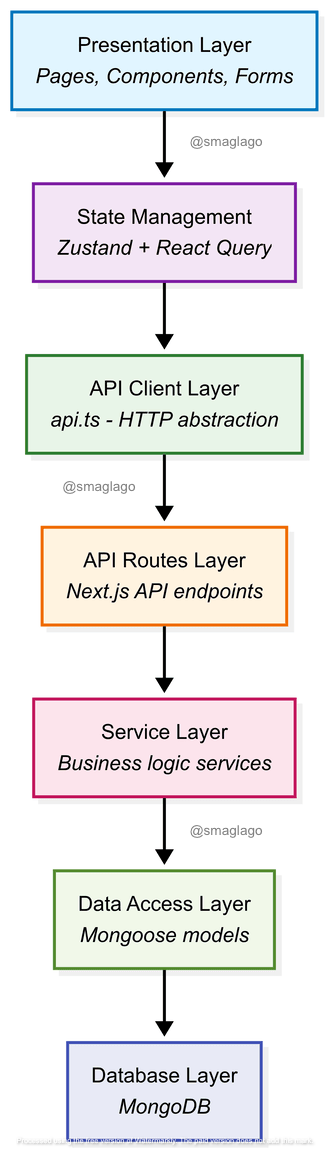
Presentation Layer: to handle user interface and user interaction
State Management Layer: to manage application state and server data synchronization
API Client Layer: to bstract HTTP communication and provides type safety
API Routes Layer: Next.js server-side endpoints that will handle HTTP requests serving as our backend
Service Layer: to contain business logic and orchestrate data operations
Data Access Layer: to define database schemas and provides data validation
Database Layer: to persistent data storage with document-based structure

